How to Rebrand Products: A Step-by-Step Guide for a Successful Launch

About Supliful
Knowing ways rebrand products the right way can be the difference between a smooth refresh and a costly failure.
Whether your packaging feels like a relic, your messaging no longer hits home, or your product has simply outgrown its original skin, a smart rebrand can reset what customers expect and kickstart new growth.
This guide walks you through the actual process, from auditing your current assets to launching a new identity that actually sticks, ensuring alignment with your mission and values.
The Product Rebranding Process: 7 Key Steps to Follow
Rebranding a product is not just about sticking on a new label. It is a calculated, organized journey that impacts everything from your design files to your office culture, reinforcing your company's mission and values.
When you do it right, you build massive momentum. When you mess it up, you just confuse the people who already buy from you.
Here is the breakdown of how to approach rebranding without losing your mind.
Step 1: Audit Your Current Product Identity
Before you try to build something fresh, you have to know what you are standing on. An honest audit shows you what is worth keeping, what is trash, and where the holes are. If you skip this, you are building your new house on a swamp.
Check these areas during your audit:
- Current product name, tagline, and logo: Do they still say who you are and who you serve?
- Packaging design and style: Does it actually stand out on a shelf or in a crowded search result?
- Brand voice: Is your tone consistent across the board, and does anyone still care?
- Reviews and sentiment: What specific words do your customers use when they talk about your product or service?
- Sales and returns: Are your drop-offs happening because people do not trust the look of the brand?
- Competitor positioning: Where do you land in the market, and is that where you want to stay in relation to your brand positioning?
Watch what people say when they think you aren't listening. Social media comments and support tickets are gold mines for raw, honest feedback.
Step 2: Define Your Rebranding Goals and Objectives
A rebrand without a goal is just an expensive coat of paint, lacking a clear brand story. You have to decide what winning looks like before you change a single pixel; otherwise, you can't prove the work was worth the money.
Common goals usually include:
- Reaching new people: Moving into a new age group, country, or retail store to expand your customer base.
- Fixing a bad image: Correcting an outdated or misunderstood reputation to differentiate from competitors.
- Matching product changes: Updating the look because the formula or quality has improved.
- Post acquisition logic: Bringing a new product under your main company umbrella.
- Beating the competition: Standing out more clearly in a crowded market.
Tie these goals to real numbers, such as sales lift, better conversion rates, or lower return volumes. Vague ideas lead to vague results, especially when trying to resonate with your customer base.
Step 3: Research Your Target Market and Competitors
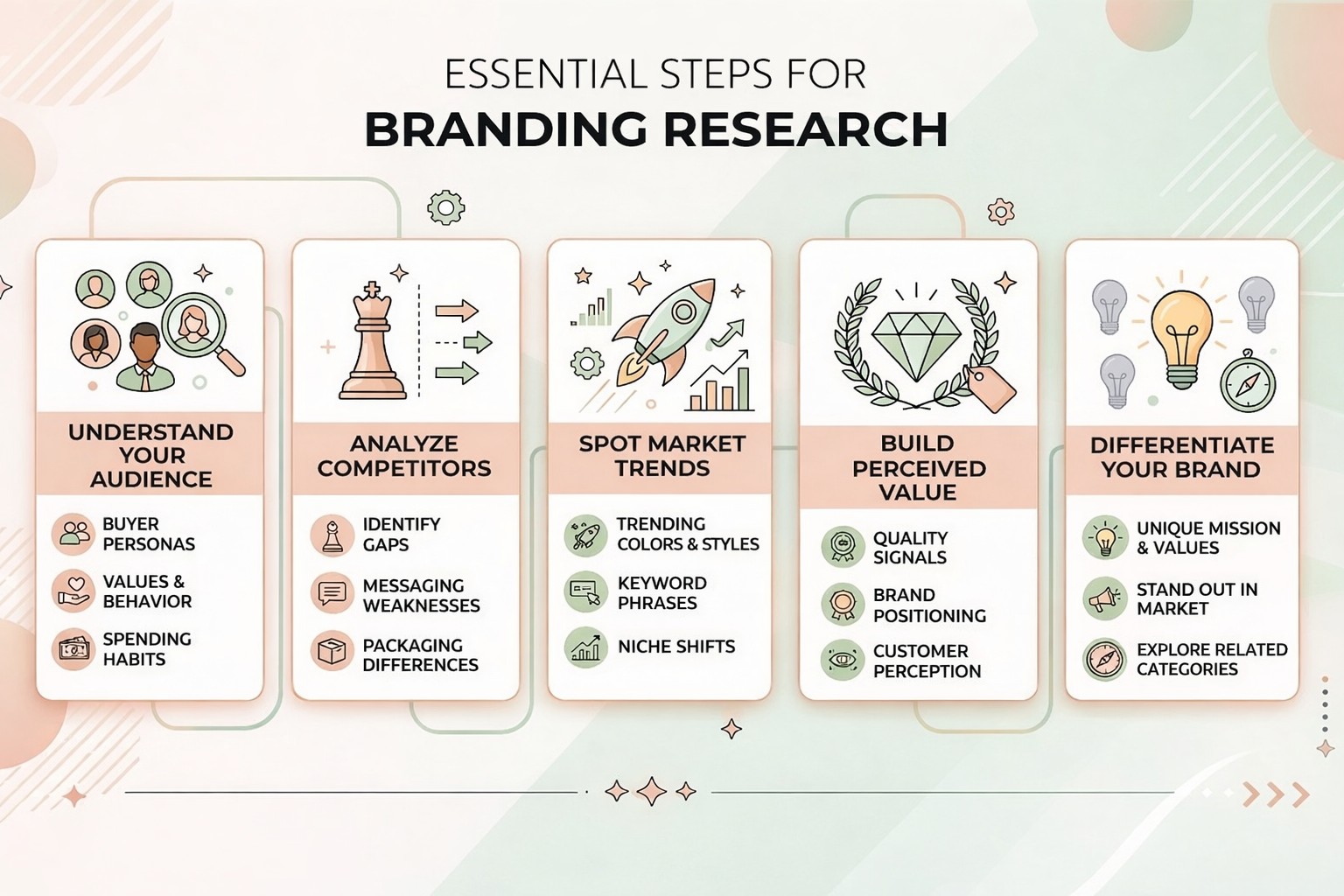
Your new identity has to speak to the right crowd and stay ahead of the pack. Skipping market research to understand your target audience is not an option. It is the bedrock of the whole project. Without it, you are just throwing darts in the dark, lacking a clear mission and values.
Look into these areas:
- Buyer personas: Who they are, what they actually value, and how they spend money.
- Competitor gaps: What are they missing in their packaging or messaging that you can grab?
- Current trends: What colors, words, and styles are starting to trend in your specific niche?
- Quality signals: How does your branding affect how much people think your product is worth?
- Search habits: What actual phrases are your customers typing into Google or Amazon?
Do not just stare at your direct rivals; instead, focus on how to differentiate your brand. Look at related categories too. See what your customers were looking at right before they landed on your page.
Step 4: Develop Your New Brand Identity
This is the fun part where the creativity happens. Remember that your brand is not just a logo; it is the entire experience someone has when they see your product. Everything has to flow together.
Focus on these updates:
- Product name: Only switch this if the current name is actually killing your growth.
- Logo and visuals: The main mark and how it looks on tiny screens versus big boxes.
- Colors and fonts: The visual shorthand that tells people who the brand is for.
- Packaging and copy: Both the physical box and every word printed on it reflect your company's mission and values.
- Brand voice: The personality and core promises that you repeat everywhere.
- Descriptions: Fresh copy for your website, retail displays, and ads.
Test your ideas early. Show your mockups to focus groups before you pay for a full production run. What looks cool on a computer screen might look terrible on a shelf.
Step 5: Align Internal Teams and Stakeholders
Rebrands often fail inside the company before they ever reach the customer. If your sales team is telling the old story while the box tells a new one, people will smell the disconnect. Getting everyone aligned is what makes the launch stick.
How to get everyone on board:
- Brief everyone early: Explain why you are changing and what the timeline looks like.
- Hand out the new assets: Give everyone the new guides, logos, and voice manuals to support the successful rebrand.
- Train your staff: Everyone from support to sales needs to speak the new language.
- Get the green light: Lock in the big decisions early so no one tries to pivot at the last second to capture market share.
- Create an FAQ: Give your team the answers they need for when customers start asking questions about our products and services.
Alignment is not just about sending an email. It is about making your team feel like they own the change.
Step 6: Plan and Execute the Rollout Strategy
The rollout is where your strategy meets the real world and your target audience. Usually, a slow phase-in is smarter than a sudden "hard" switch. It gives you a chance to fix small mistakes before they become huge problems.
Plan these parts carefully:
- Inventory: Decide if you are going to sell through the old stuff first or just pull it all.
- Retail partners: Get your distributors ready before the new boxes arrive at their warehouse.
- Digital updates: Your website, social pages, and email signatures all need to change at once.
- PR and news: Make sure you are the one telling the story of why you rebranded, focusing on differentiation from your competitors.
- Ad campaigns: Use paid ads to tell people about the new look during the launch.
- Customer emails: Send out a clear message explaining that the look is new, but the quality is the same.
Be open with your fans. Honesty beats marketing spin every single time.
Step 7: Monitor Performance and Gather Feedback
The job is not done just because the new product is on the shelf. The first three months of data will tell you if you hit the mark or missed it in terms of your brand strategy. Watch the numbers closely and be ready to tweak things.
What to track:
- Sales speed: Compare your new numbers to your old ones week by week.
- Customer sentiment: Are people happy about the change or confused by it?
- Web stats: Watch your bounce rates and conversion numbers on the new pages.
- Social buzz: See how people are reacting to the new visual style online.
- Returns: If these go up, it usually means your new branding is confusing people.
- Retailer feedback: Ask your partners how the new look is moving in stores.
Do not wait for people to complain. Go out and ask your customers and your team what they think while the change is still fresh.
Common Product Rebranding Mistakes to Avoid
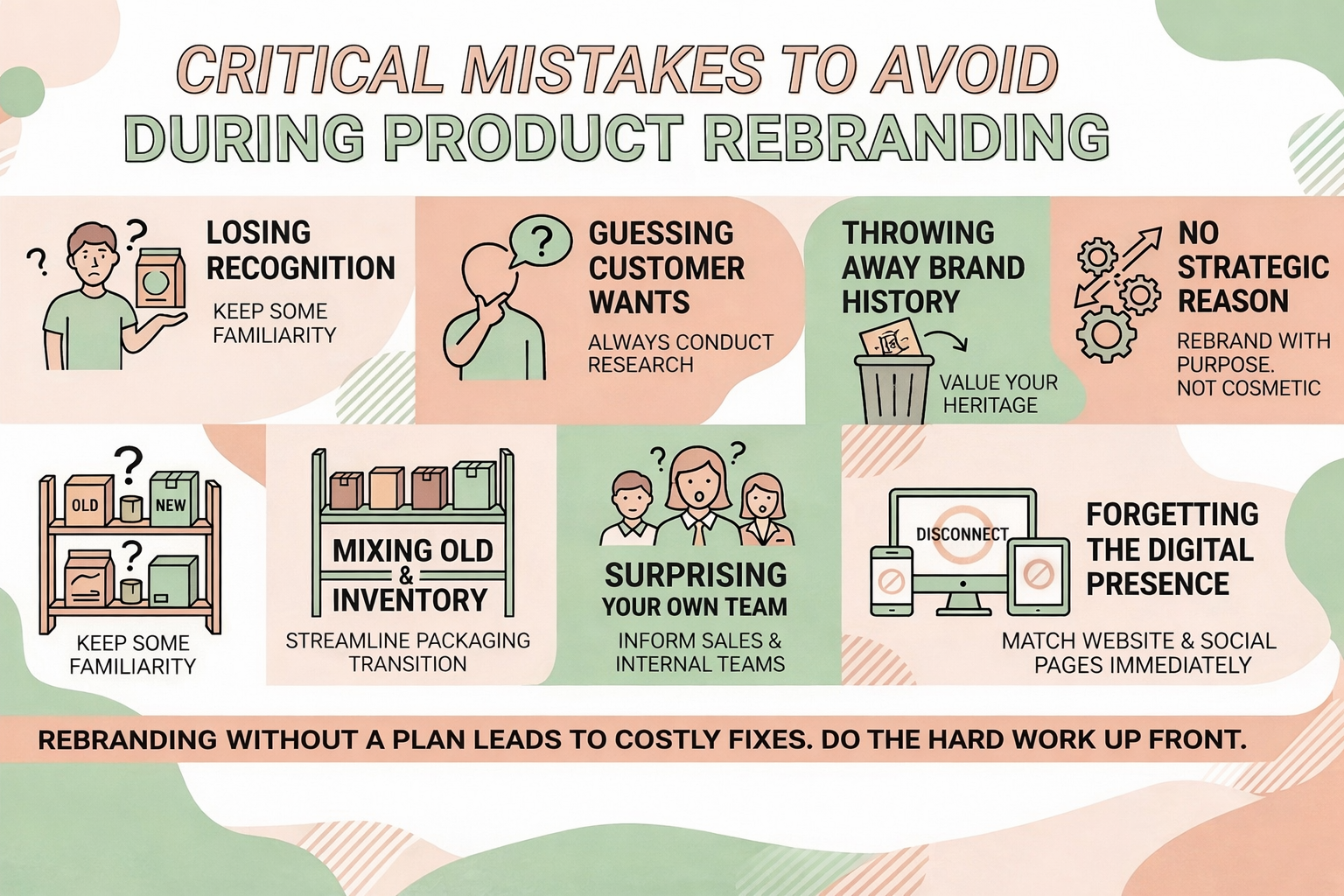
Even the biggest companies mess this up. Most errors happen because people move too fast or forget to talk to their target audience.
Watch out for these traps:
- Changing everything at once: If people cannot recognize you, they won't buy you. Keep a few things familiar to maintain customers’ perceptions while introducing a new direction.
- Guessing instead of researching: Thinking you know what customers want without asking them is a recipe for disaster.
- Ignoring your history: Sometimes the old logo has real value in your brand story. Do not throw it away just for the sake of it.
- Rebranding for no reason: Can lead to confusion about your brand strategy and negatively affect customers’ perceptions. Cosmetic changes without a strategy rarely help your bottom line.
- Messing up the inventory: Can hurt your brand positioning. Having old and new boxes mixed on a shelf creates total confusion.
- Surprising your own team: If your sales staff does not know about the rebrand, they cannot sell it.
- Forgetting the internet: Can severely harm your company’s reputation in today's digital age. Make sure your website and social pages match the new boxes immediately.
The biggest mistake you can make is rebranding without a plan and having to fix it six months later, which undermines your brand strategy. Do the hard work up front.
Start Building Your New Product Identity Today
Rebranding your products is one of the smartest moves you can make if you do it with a plan. Start with an audit, pick a goal, and talk to your customers.
The winners aren't always the ones with the most money. They are the ones who understand their audience. If your product already has fans, you have the data you need to make the right call.
Knowing how to rebrand a product effectively is about respecting what worked while fixing what didn't. Move with a purpose, and treat the launch as just the beginning.
FAQ
Yes, it happens every day in the world of brand personality. It just means you are changing the name, the box, or the message without necessarily changing the actual stuff inside.
Usually, yes; it’s time to rebrand. When you buy from Alibaba and sell under your own name, it is called private labeling. Learning how to brand a product from Alibaba is about finding suppliers who allow "OEM" or private label deals. Just make sure you aren't stealing anyone else's trademark and get a legal check for things like electronics or supplements.
Only if you have to. If the name is holding you back or sounds old, change it. But if people already know and love the name, try to keep it and just fix the visuals.
To stay successful. You rebrand to beat new competitors, reach new types of customers, or just to make sure you don't look like a fossil as the market moves forward.
It changes the "vibes" or signals you send out. The box, the price, and the words you use create an expectation before the customer even opens the product. Done well, rebranding products A new logo can turn a "cheap" item into a "must have" brand.
The main things are your logo, your packaging, and your website. But do not forget the "boring" stuff like sales decks and customer service scripts. Everything needs to match the new identity, including the color palette and marketing materials.


Related blogs
.avif)
Influencer Marketing ROI Forecaster Calculator: Know Your True ROI Before Spending a Dollar on Influencers
.avif)
.avif)
.avif)